

Biography
Nikos Paktitis
Nikolaos Paktitis was born in Piraeus in 1930 to a Corfiot father and a mother from Syros. He died on 23 June 2021 and was buried at the Cemetery of Agioi Pantes in Sinarades. He graduated from the First Gymnasium of Corfu in 1949 and from the Marasleio Teacher Training Academy in 1951. He served in the army as a reserve officer from 1952 to 1954. He was appointed as a teacher in 1954 and served for 33 years, ten of them in one-teacher schools and 23 in larger, multi-teacher schools. At the same time, he devoted himself to literature and poetry, but particularly to history and folklore, making a significant contribution to the cultural development of the region.
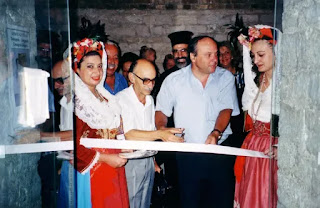
He served as president of the Sinarades Philharmonic Society and the Sinarades Cultural Association. In 1980, together with friends, he founded the Folklore Society of Corfu, based in the city of Corfu. Within the framework of the Society, he established the Historical-Folklore Museum of Central Corfu in Sinarades, the only museum of its kind on the island of Corfu and one of the most notable of its kind in Greece. The museum attracts approximately 7,000 visitors each year, including tourists, researchers and schoolchildren.
In 1999, he founded the Museum of Corfiot Ceramics, which was housed in the New Fortress of Corfu with the support of the Municipality of Corfu. At the same time, he collaborated with other associations in organising celebrations dedicated to Corfiot folk traditions, which attracted broad participation from the local community.
He participated in five Pan-Ionian Conferences, presenting papers on various subjects. On his initiative, the Folklore Society established an educational centre at its office in the city of Corfu. The centre included a lending library, collections relating to Corfiot architecture and ceramics, as well as a collection of photographs and texts concerning the 1896 Olympic Games. The educational centre was visited by secondary school students and university students for study and the exchange of knowledge on various subjects, primarily relating to the history and ethnography of Corfu.
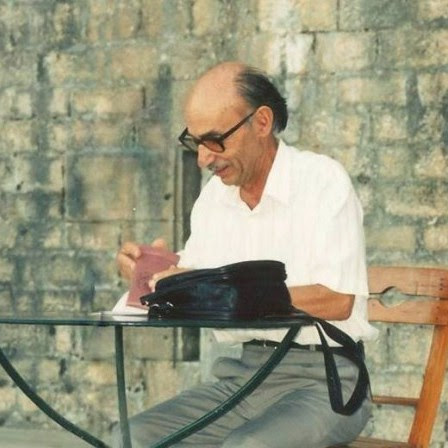
He lived in Corfu, which he continuously researched and studied, and was deeply committed to the protection of its natural and architectural heritage.
Published works
The following books by Nikolaos Paktitis have been published:
- Cyprus, Land of Heroes. Corfu, 1956.
- Corfu, the Bride of the Ionian Sea. Corfu, 1960.
- Beginnings (poetry). 1967.
- Ioannis Kapodistrias, the Tragic Founder of the Modern Greek State. Corfu, 1976.
- The Old Fortress of Corfu (The Byzantine-Medieval Acropolis). Thessaloniki, 1982.
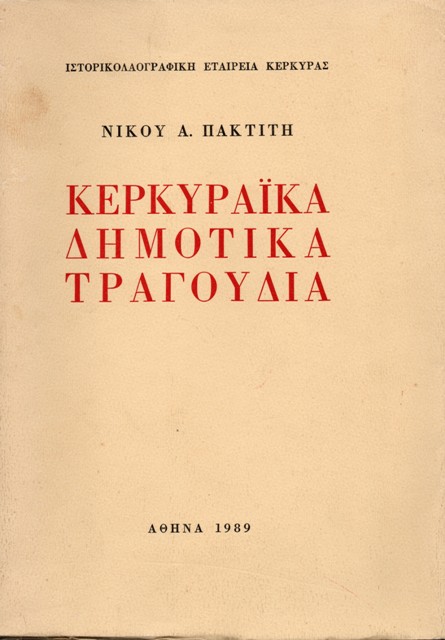
- Corfiot Folk Songs. Athens, 1986.
- Corfiot Ceramics and Its Museum. Corfu, 2003.
- The New Fortress and the Siege of 1716. Corfu, 2004.
- He contributed to the Local History handbook published in 2001 by the Department of Archives, Library Science and Museology of the Ionian University.
Unpublished works
- Corfiot Folk Culture
- The Remaining Walls and Their Gates
Awards and distinctions
In recognition of his contribution, Nikolaos Paktitis received distinctions from the following organisations:
- Panhellenic Committee of the Union of Cyprus, 22 October 1956.
- Linguistic Society of Athens – three awards, in 1967, 1971 and 1974, for three separate studies.
- Scouts of Western Greece, 3 February 1973.
- Association of Teachers and Kindergarten Teachers of Corfu, 12 July 1972.
- Prefecture of Corfu, 13 January 1977.
- Association of Katogarouniaton of Athens, 23 August 1992.
- Sinarades Philharmonic Society, 25 December 1996.
- Corfiot Events Organisation, 18 January 2002.
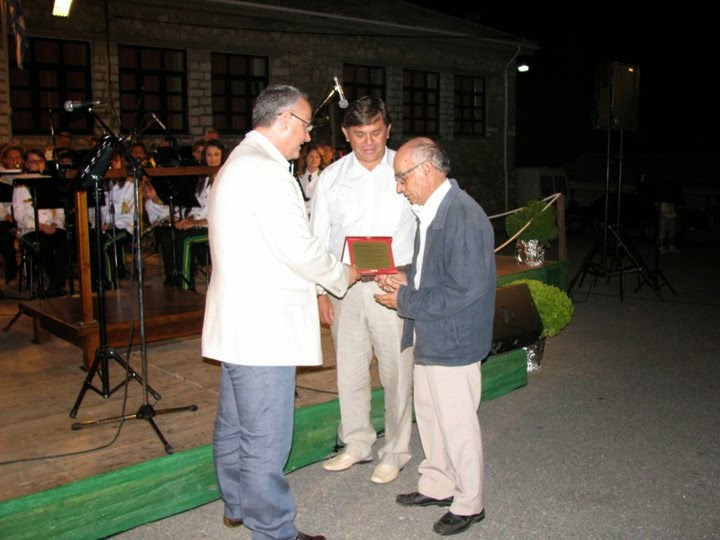
Award presented by all the organisations and associations of Sinarades in recognition of his contribution both to the village and to Corfu. August 2011, prior to the concert of the Sinarades Philharmonic Society, held in the courtyard of the local elementary school.
“Corfu Folk Songs”
When Nikos Paktitis first published his study “Corfu Folk Songs” in 1989 (published by the Historical and Folklore Society of Corfu), it was the most comprehensive work ever produced in this field. Decades earlier, the works of Martzoukos and Bounia had preceded it; these were among the first efforts to compile folkloric material from the island.
Today, seventeen years after its first publication, Nikos Paktitis’s study remains the most comprehensive in its field and the most important reference for anyone studying the folklore of Corfu.
This study was republished by “Dodoni” Publications with the support of the “Association of Sinara Residents of Athens” in 2005.
The study includes:
An extensive preface that provides a general analysis of folk songs and, more specifically, documents the formation and evolution of Corfiot folk songs.>
A collection of Corfiot folk songs, divided into the following categories:
Akritika
Paraloges
Religious and Devotional Songs
Love Songs
Wedding Songs
Mocking or Satirical Songs
Death Songs—Laments
Children’s Songs – Songs of Exile – Proverbs – Work Songs – Social Songs, and various others.
The study is supplemented with relevant bibliography and photographic material.
NOTABLE FIGURES
The NOTABLE FIGURES page presents individuals who have made significant contributions to historical research, folklore, literature, and culture in general. They are Corfiotswith a particular love for their homeland, whose creativity and work have been closely associated with the Historical Folklore Society of Corfu. All of them have contributed to the effort to preserve, promote, and highlight the island’s cultural heritage.
The Writer Stelios Gramménos
Stelios Gramménos was born in Corfu, in the village of Sinarades, to a father from Sinarades and a mother from the village of Kato Korakiana. He spent his childhood between these two villages. He studied Political Science and was appointed to the Ministry of the Interior, where he progressed through the ranks and completed his career. As an official of the Ministry, he participated in the Central Negotiating Committee for Greece’s accession to what was then the European Economic Community, dealing with matters concerning population movement. His experience at the Ministry in these areas enabled him to write his scholarly work, Greek Nationality Law, which has so far gone through five successive editions. He also wrote his Genealogy, a work drawing upon personal and family memories spanning generations. At the same time, he periodically published narratives in newspapers focusing on Corfu-related subjects, dealing primarily with themes drawn from the life and traditions of the two villages of his family origins. The present publication includes narratives that have not previously been published, some of those that have already appeared in print, as well as excerpts from his Genealogy which, in the author’s judgement, are of wider interest.
(From the book)
Από το διαδίκτυο
Κύθηρα: Μύθος και πραγματικότητα
Τόμος Β΄: Ιστορία, πολιτισμός, περιβάλλον: Α΄ διεθνές συνέδριο Κυθηραϊκών Μελετών, 20-24 Σεπτεμβρίου 2000
επιμέλεια: Γεώργιος Λεοντσίνης, Ευαγγελία Κουνέλη
εισήγηση: Γεώργιος Λεοντσίνης, Ελευθέριος Αλεξάκης, Μαρία Ανδρουλάκη, Δικαίος Βαγιακάκος, Νικόλαος Βερνίκος, Φανούριος Βώρος, Γιώργος Δελόπουλος, Cecilia Ghetti, Virgilio Giormani, Γεώργιος Θανόπουλος, Ρέα Κακάμπουρα – Τίλη,Εμμανουήλ Καλλίγερος, Σπύρος Λουκάτος, Άννα Λυδάκη, Ηλίας Μαρσέλος, Κοσμάς Μεγαλοκονόμος, Γεώργιος Μοσχόπουλος, Γεράσιμος Μπάλλας, Νίκος Πακτίτης,Αννίτα Πανάρετου, Δημήτρης Σακκής, Μανόλης Σέργης, Σούλα Τόσκα – Κάμπα
Between Koukouritsa and Akleris – Stelios F. Gramménos
Stelios Gramménos was always an active member of the communities of the two villages of his family origins—Sinarades and Korakiana—devoting every opportunity available to him to serving their common goals and aspirations and contributing to progress in the villages.
By way of example, it is worth mentioning that he was the driving force behind the establishment of the Association of Sinarades Residents of Athens and served as its first president. He was also the person who, while serving as an official of the Prefecture of Florina, arranged for the newly established Philharmonic Band of Korakiana to be invited to Florina, on what was both its first such appearance and its inaugural establishment as a travelling ensemble. Its impressive performance in Florina filled everyone with optimism and marked the beginning of its subsequent successful course.
At the same time, drawing upon his talent for the written word, he periodically published in Corfu-oriented newspapers and other publications highly characteristic texts that primarily recorded events and aspects of everyday life, traditions, customs, and activities in our villages that have now disappeared. In doing so, he brought nostalgic memories to life for older generations while opening a window for younger ones, enabling them to understand not only what was distinctive about, but also the everyday life of, the people of the generations that came before them. All this was expressed in a flowing language, like the water of a spring, enriched with words and expressions from our local dialect.
In this publication, the author presents a selection of previously published texts, together with others appearing in print for the first time, all dealing with the same subject matter. These texts bear the distinctive mark of his many gifts as a writer, as well as the richness of his expression and the ease and confidence with which he handles the written word.
(…From the Preface)
“What remains particularly noteworthy in my memory, as an expression of the need for communication among relatives from both sides, is the group gatherings that were planned, organised, and held once, or even twice, a year. They took place at a designated spot in the Ropa plain, approximately halfway between the two villages, Korakiana and Sinarades.
As I now understand it, these gatherings were the event of the year for both communities. They brought a special dimension to the everyday lives of those people, and were attended not only by close and more distant relatives, but also by neighbours and friends from both villages.”
(…In Place of a Preface)
Konstantinos D. Karamoutsos
He was born in 1941 in Afra, Corfu. He studied Philology, Journalism, Public Administration and Public Relations in Athens. He worked as a reporter for the Athenian press. From 1966 to 1997, he served as a secondary-school teacher.
He was fortunate to establish and develop the Gymnasium–Lyceum of Agros, Corfu, as well as the Corfu Music School.
He published the following books: Ten Florias: His Artistic and Scholarly Work, Corfu, 1997; Corfiot Aristocratic Country Houses, Vol. I, Municipality of Parelioi, Corfu, 2006; and Genealogies of the Souliotes, Corfu, 2007.
As a photographer, he held the following exhibitions: in Athens, at Ekfrasi 1, Trees (1963), and at Ekfrasi 2, My Teachers(1964). In Corfu, he presented The Vernacular Architecture of the Village of Sinarades (2005), a five-volume work deposited at the Museum of the Historical and Folklore Society of Sinarades, Corfu.
He married Mary P. Georgiou, and they had two children, Takis and Rozanténia, and a grandson, Theodoros Tsirigotis.
His Death as Reported in the Press
The distinguished Corfiot philologist, historical researcher and writer Konstantinos D. Karamoutsos died tragically yesterday, Friday, 4 November 2011, in Corfu. He was struck by a private truck and died three hours later in the hospital to which he had been taken.
The Cultural and Environmental Association of Sinarades “I Keradikia” and the Historical and Folklore Society of Corfu (Sinarades Museum) extend their deepest condolences to the family of Kostas Karamoutsos.
His unexpected death saddened all the people of Sinarades, as he was a scholar and a man whom we had known personally and who had demonstrated his genuine love for our village.
His 2005 photographic exhibition, The Vernacular Architecture of the Village of Sinarades, which was presented both in the village and at the Municipal Theatre, while the entire collection was donated to the Sinarades Folklore Museum of Mesi, was a landmark event in the history of our village.
The album Corfiot Aristocratic Country Houses of the Municipality of Parelioi was another important contribution to the entire area of Central Corfu.
The loss caused by the death of this tireless researcher of our local history is irreplaceable. His work and contribution will never be forgotten.
On behalf of the Boards of Directors of the Associations
Ioannis Borbotis
President of the Cultural and Environmental Association
Fontas Alamanos
President of the Historical and Folklore Society of Corfu
Georgios H. Sourtzinos
Autobiographical Note, 5 April 2014
Georgios H. Sourtzinos was born in Corfu in 1943, where he completed the six-year secondary school of the time. After serving as a reserve non-commissioned officer in the Royal Hellenic Air Force, he joined the City Police, where he served for eight years in Athens.
At the time, the legislation concerning local residency did not allow him to serve in his homeland, which he loved dearly. For this reason, he resigned from the police force and returned to Corfu, where he pursued a career in the private sector.
From his final years of secondary school, he had developed a particular interest in depictions of Corfu from past centuries, as he recognised in them the history, traditions and folklore of his island.
While serving with the City Police in Athens, he had his first opportunity to begin searching for the well-known engravings depicting Corfu—woodcuts, copperplate engravings and lithographs. From then on, he began collecting prints whose subject matter was exclusively related to Corfu.
Today, his collection comprises more than 300 authentic prints, dating from 1486—the earliest known depiction of Corfu—to 1962.
This collection inspired him to undertake research into and study the history of Corfu.
In 1998, he published his first book, entitled Corfu: Journeys Through Time. The book was translated into English and German, and is currently in its third edition.
In 2006, he published his second book, entitled Toponyms: Linguistic Testimonies in the Historical Course of Corfu. The book is currently in its second edition.
In 2011, he published his third book, entitled Roptra of Corfu (door knockers of Corfu)
In 2022, he published his fourth book, entitled Corfu in the Interwar Period, 1918–1939.
Part of his collection of prints was exhibited in 1998 and 2012 at the Municipal Gallery of Corfu, as well as at the Archaeological Museum of Ioannina in 2014.
For many years, Georgios H. Sourtzinos served as a member of the Board of Directors of the Historical and Folklore Society of Corfu.
Under the title Toponyms, Linguistic Testimonies in the Historical Course of Corfu, Georgios H. Sourtzinos presents his latest scholarly work, published by the Historical and Folklore Society of Corfu.
The book provides a detailed record of the names of various villages, sites, locations, and areas of Corfu. As the author explains, the term toponyms refers to distinctive and specific names given to places and areas within a particular region.
Every toponym contains information of a social, religious, topographical, geographical, folkloric, and other nature. These toponyms are scattered throughout the city and the surrounding areas of the island. They are connected with the history of Corfu, its traditions, customs, language, and even with particular historical events.
Thus, we encounter names such as Saroko, Spilia, Mouragia, and Spianada, Kampielo, among many others.
Toponyms may be classified as historical, environmental, anthroponymic, hagiotoponymic, and patria-toponymic.
Corfu: A Journey Through Time – Georgios H. Sourtzinos
Historical and Folklore Society of Corfu
Third Edition
History, Monuments, Museums, Historical and Archaeological Sites, Prints
“My work on this publication was prompted by thirty years of searching for, collecting, researching and studying Corfiot prints, as well as by my love, interest and sensitivity towards Corfu and towards everything that has survived, both in the city and throughout the island, from the invaluable heritage of so many cultures over the course of time. This book aims to provide the reader with a general overview of Corfu and of all those elements that make up its history, monuments, architecture, and long-standing intellectual and cultural heritage.”
[…G. Sourtzinos]
This book, with the subtitle “History, Monuments, Museums, Historical and Archaeological Sites, Prints”, which gives an indication of the breadth of its contents, constitutes a new and valuable addition to the bibliography of Corfu. Its 108 thematic sections are presented through a rich selection of carefully chosen colour images, accompanied by concise and economical descriptions.
In addition, the book contains various mythological and folkloric elements that further enrich its content. The author introduces an interesting innovation: he has organised the material according to geographical rather than chronological frameworks. This makes the book particularly accessible to read, as it is essentially a photographic album, rich in images and engravings spanning different periods.
[…From the Preface by Avgoustos Sordinas]
Roptra of Corfu
A new illustrated volume by the renowned researcher of old Corfu, Georgios Sourtzinos, focusing on a detail of local art that reveals remarkably interesting information about the social standing, financial status, and even the artistic preferences of the people of old Corfu, as reflected in the choices they made when selecting the door knockers they placed on the entrances to their homes.
Subtitle: Forgotten Folkloric Ornaments on Front Doors

Opening hours
The Folklore Museum is open from May 1st to October 31st, every day of the week.
Opening hours 9:00 a.m. – 2:00 p.m.
Contact
Folklore Museum
+30 26610 54962
Museum Manager
+30 6980118959
Sinarades Folklore Museum © 2026-2027. All rights reserved.
Privacy Policy